How Often Should You Get a DEXA Scan to Track Body Composition?
This is a subtitle for your new post
How Often Should You Get a DEXA Scan to Track Body Composition?
If you're actively trying to lose fat, gain muscle, or improve your body composition, it can be tempting to measure your progress constantly.
But when it comes to DEXA scanning, more frequent testing does not necessarily mean better information.
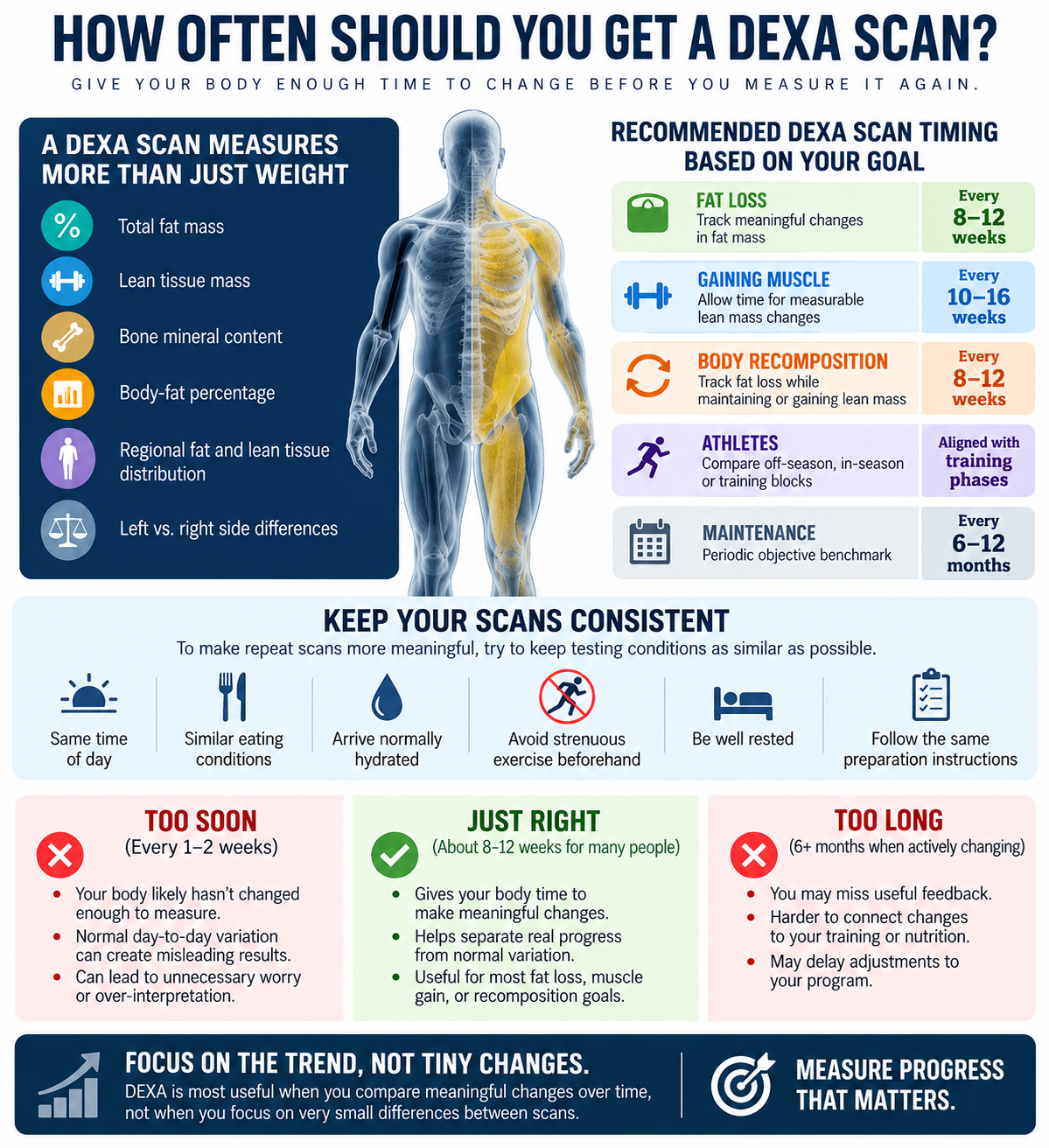
For many people actively working toward a body-composition goal, repeating a DEXA scan approximately every 8 to 12 weeks can be a practical starting point.
That is not a universal medical rule.
The appropriate timing depends on what you are trying to change, how quickly meaningful change is likely to occur, and whether the difference between two scans is large enough to separate actual progress from normal biological and measurement variability.
The goal should not be to scan as often as possible.
The goal should be to give your body enough time to change before you measure it again.
What Does a DEXA Body Composition Scan Measure?
DEXA, also called DXA, uses two low-energy X-ray beams to estimate several components of body composition.
A full-body body-composition scan can provide information including:
- Total fat mass
- Lean tissue mass
- Body-fat percentage
- Bone mineral content
- Regional fat and lean tissue distribution
- Differences between areas such as the arms, legs, and trunk
That makes DEXA useful for tracking changes that a bathroom scale cannot identify.
If you lose five pounds, for example, the scale cannot tell you how much came from fat versus lean tissue.
Likewise, someone could lose several pounds of fat while gaining lean mass and see relatively little change in total scale weight.
That is where body-composition testing becomes more informative than body weight alone.
Why Not Get a DEXA Scan Every Week?
Because your body composition probably has not changed enough in one week for the comparison to be particularly useful.
More importantly, some of the differences seen between closely spaced scans can come from normal biological variation rather than actual changes in fat or muscle tissue.
DEXA is a highly reproducible body-composition method, but no measurement system is perfectly free from variability.
Research examining repeated DXA scans has found very good reliability for whole-body fat and lean-mass measurements. However, the ability to detect small changes becomes more challenging when day-to-day biological variability is added to normal technical measurement error.
In other words: A number can change without your body having meaningfully changed.
That is one of the most important concepts to understand when comparing DEXA results.
Hydration Can Affect Your Lean-Mass Reading
One reason closely spaced scans can be misleading is that lean tissue contains a large amount of water.
DEXA does not simply identify skeletal muscle and place it into a separate compartment. Its lean soft-tissue measurement includes water contained within lean tissue.
That means changes in hydration can influence the amount of lean tissue reported by the scan.
In one controlled study, drinking fluid produced increases in measured tissue mass and lean tissue mass that corresponded with the fluid consumed.
Another study examining exercise-induced dehydration followed by carbohydrate loading found even larger apparent changes.
After dehydration, participants showed an average decrease of approximately 1.7 kg in DEXA-measured lean tissue. After rehydration and carbohydrate supercompensation, measured lean tissue increased by approximately 2.4 kg, even though those short-term differences obviously did not represent pounds of muscle being lost and rebuilt within a few days.
That is an excellent example of why context matters when interpreting a DEXA scan.
Food, Exercise, and Daily Activity Can Also Affect Results
Hydration is not the only source of variation.
Researchers studying physically active adults found that normal daily activities and eating before a scan increased variability in both total and regional body-composition measurements.
The researchers concluded that standardized testing conditions and fasting before measurements were practical ways to reduce this biological noise.
Exercise can have a similar effect.
In another study, participants underwent a DEXA scan before and after either resistance training or cycling. Exercise, together with the associated food and fluid intake, produced changes in body-composition estimates and increased typical measurement error.
This does not mean DEXA is unreliable.
It means that if you want to compare two scans, you should make the testing conditions as similar as reasonably possible.
Consistency Matters Almost as Much as Timing
Imagine your first scan is:
- At 7:00 a.m.
- Before breakfast
- Before exercising
- Normally hydrated
Then your second scan is:
- At 3:00 p.m.
- After multiple meals
- After drinking several liters of fluid
- Shortly after a hard workout
Those two scans are not being performed under equivalent physiological conditions.
A better approach is to make repeat scans as consistent as reasonably practical.
For example:
- Schedule around the same time of day
- Follow similar eating conditions
- Arrive normally hydrated
- Avoid performing the scan immediately after strenuous exercise
- Follow the same preparation instructions each time
You do not need to turn your DEXA appointment into a laboratory experiment.
You simply want to reduce unnecessary variables so that the difference between Scan #1 and Scan #2 is more likely to represent an actual change in your body.
So, How Long Should You Wait Between DEXA Scans?
There is no single interval that is ideal for everyone.
For many people actively pursuing fat loss, muscle gain, or body recomposition, approximately 8 to 12 weeks is a reasonable practical interval.
Why?
Because that generally allows substantially more time for meaningful physiological change than scanning every week or two.
The appropriate interval should ultimately be based on how quickly you reasonably expect your body composition to change.
If your primary goal is fat loss
Approximately 8–12 weeks may provide enough time to see a meaningful change in fat mass if you are consistently following a sustainable program.
If your fat-loss rate is intentionally slow, waiting longer may provide a clearer comparison.
If your primary goal is gaining muscle
Muscle growth is usually gradual.
For someone pursuing hypertrophy, scanning too frequently may result in differences that are smaller than normal short-term variation.
Waiting 10–16 weeks, or sometimes longer, may provide a more useful picture of whether lean mass is trending upward.
If your goal is body recomposition
Body recomposition means losing fat while maintaining or gaining lean tissue.
Because both processes may be occurring simultaneously, scale weight can remain relatively stable.
A DEXA comparison every few months can be particularly useful in this situation because it allows you to look separately at changes in fat mass and lean tissue rather than judging progress entirely by body weight.
If you are maintaining
If your goal is simply maintaining your current body composition, there may be little reason to scan every few months.
Testing every 6–12 months may be sufficient for someone who simply wants a periodic objective benchmark.
Again, these time frames are practical guidelines, not medical prescriptions.
What About Athletes?
Athletes may have different reasons for testing.
A competitive athlete might use DEXA to compare:
- Off-season versus in-season body composition
- Fat mass during different training phases
- Regional lean-mass changes
- Right-versus-left differences
- Changes following a strength or hypertrophy program
Research involving elite athletes has demonstrated that DEXA can identify body-composition changes occurring across training seasons when those changes are large enough to exceed normal measurement variability.
For athletes, the best testing schedule may therefore align with training blocks, rather than arbitrary calendar intervals.
For example:
Baseline → training block → follow-up measurement
That creates a meaningful question: Did my body composition change during this phase of training?
That is generally more useful than scanning simply because another month has passed.
What About Someone Using a GLP-1 Medication?
Someone losing substantial weight may be interested in more than the number on the scale.
Weight loss can include changes in both fat mass and lean tissue.
A periodic DEXA scan can help someone objectively track those components separately.
The appropriate frequency depends on the rate of change and should not replace medical follow-up with the prescribing provider.
At Body Fat USA, our role is to provide body-composition data and help clients understand the measurements on their reports. We do not prescribe nutrition, exercise programs, or medication management.
How Much Change Is “Real”?
This is where DEXA interpretation gets especially interesting.
Scientists sometimes use something called least significant change, or LSC.
The idea is straightforward: How much does a measurement need to change before we can be reasonably confident that the difference is larger than normal measurement error?
Research in resistance-trained athletes has demonstrated that the threshold can differ depending on whether researchers look at back-to-back scans or scans performed on separate days.
When scans occurred on consecutive days, biological variability increased the amount of change required before researchers could confidently identify a meaningful difference.
This matters because clients sometimes focus heavily on very small changes: “My lean mass increased 0.3 pounds.”
Or: “My body-fat percentage increased 0.2%.”
Those numbers may appear very precise on a printed report.
That does not necessarily mean a biological change that small can be interpreted with the same degree of certainty.
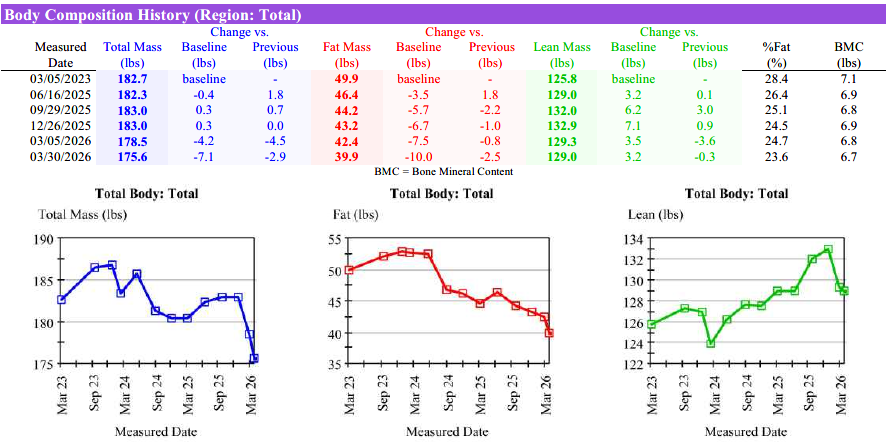
Instead of obsessing over tiny differences, look at the overall trend.
Look at Pounds, Not Just Percentages
Body-fat percentage receives a lot of attention, but it is only one part of the picture.
Suppose someone goes from: 30% body fat to 28% body fat.
That certainly sounds positive.
But we still want to know:
- How much fat mass changed?
- How much lean tissue changed?
- How much did total body weight change?
A decreasing body-fat percentage can result from losing fat, gaining lean tissue, or a combination of both.
Likewise, a person can lose weight while losing both fat and lean tissue.
That is why comparing fat mass, lean mass, body weight, and body-fat percentage together generally provides a better understanding of progress than focusing on one percentage.
Should You Scan More Frequently During Rapid Weight Loss?
Not necessarily.
Faster changes in body weight might justify a shorter interval in certain situations because larger body-composition changes may occur more quickly.
But the same principle still applies: The scan should answer a useful question.
If you already know your weight is changing rapidly, scanning every couple of weeks may produce more information without necessarily producing more useful information.
A better approach may be to establish a baseline and allow enough time for a meaningful change to occur before measuring again.
Is It Safe to Have Repeat DEXA Scans?
DEXA uses ionizing radiation, but the radiation exposure associated with DXA is very low compared with many other medical imaging procedures.
The International Atomic Energy Agency reports that radiation exposure varies by scanner design and protocol. Typical effective doses for whole-body DXA may range from roughly 1 microsievert with some pencil-beam systems to approximately 10 microsieverts with some fan-beam systems, though actual exposure depends on the specific equipment and scanning protocol.
For perspective, RadiologyInfo, a resource produced by the American College of Radiology and Radiological Society of North America, lists approximately 0.001 mSv as a typical effective dose for bone densitometry and notes that actual dose varies depending on the machine, patient, and technique.
That does not mean radiation exposure should be ignored or that someone should undergo unnecessary scans simply because the dose is low.
At Body Fat USA, DEXA appointments are subject to our established screening and medical-approval requirements.
The Best Reason to Schedule Your Next DEXA
Instead of asking: “Has it been eight weeks yet?”
Ask: “Has enough happened since my last scan that another measurement would help me evaluate what I’m doing?”
That might mean you have:
- Completed a structured fat-loss phase
- Finished a strength or hypertrophy training block
- Lost a meaningful amount of body weight
- Changed your training approach
- Reached a plateau
- Started a new phase of your program
- Maintained your weight while noticing visible changes in your physique
When one of those things happens, another DEXA scan may provide useful information.
Establish a Baseline Before You Need the Comparison
One of the best times to have a DEXA scan is before beginning a major body-composition change.
A baseline gives you something objective to compare against later.
Instead of asking: “Did I lose weight?”
You can eventually ask:
- “How much fat mass changed?”
- “What happened to my lean tissue?”
- “Did my body composition improve even though my scale weight barely moved?”
Those are much more useful questions.
The Bottom Line
For many people actively trying to change their body composition, 8–12 weeks between DEXA scans is a useful starting point.
But there is nothing magical about that interval.
Someone losing weight rapidly may have a reason to measure sooner.
Someone slowly building muscle may benefit from waiting longer.
Someone maintaining their current composition may only need occasional testing.
The most important principle is simple: Give your body enough time to change before measuring it again.
And when you do repeat the scan, try to keep your preparation and testing conditions reasonably consistent.
DEXA is most useful when it is treated as a tool for identifying meaningful trends over time, not as a weekly scoreboard.
At Body Fat USA in Denver, we provide full-body DEXA body-composition testing for people who want objective data on fat mass, lean tissue, body-fat percentage, and regional body composition.
Whether you are establishing your first baseline or comparing results after months of work, the goal is the same:
Measure the change that actually matters.
References
Nana A, Slater GJ, Hopkins WG, Burke LM. Effects of daily activities on dual-energy X-ray absorptiometry measurements of body composition in active people. Medicine & Science in Sports & Exercise. 2012.
Nana A, Slater GJ, Hopkins WG, Halson SL, Martin DT, West NP, Burke LM. Effects of exercise sessions on DXA measurements of body composition in active people. Medicine & Science in Sports & Exercise. 2013.
Toomey CM, McCormack WG, Jakeman P. The effect of hydration status on the measurement of lean tissue mass by dual-energy X-ray absorptiometry. European Journal of Applied Physiology. 2017.
Peeters MW, Claessens AL. Effect of deviating scanning position on body composition measurements using dual-energy X-ray absorptiometry. Related DXA precision research demonstrates the importance of standardized positioning and longitudinal measurement conditions.
Morrison SA, Petri RM, Hunter HL, Raju D, Gower B. Comparison of the Lunar Prodigy and iDXA dual-energy X-ray absorptiometers for assessing total and regional body composition. DXA methodology literature supports attention to equipment and protocol consistency when evaluating longitudinal change.
International Atomic Energy Agency. Dual Energy X Ray Absorptiometry for Bone Mineral Density and Body Composition Assessment. IAEA Human Health Series.
RadiologyInfo.org. Radiation Dose from X-Ray and CT Exams. American College of Radiology and Radiological Society of North America.